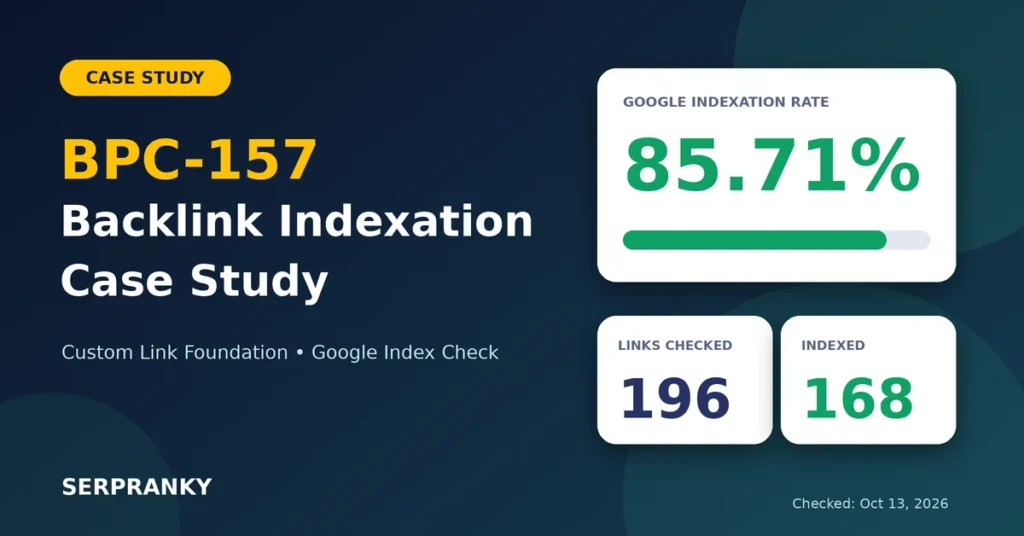
BPC-157 Backlink Indexation Case Study
Service Provider: SerpRanky
Project: BPC-157
Service: Custom Link Foundation
Focus Areas: Multi-Category Link Building, Indexable Link Foundation, and Backlink Index Monitoring
Indexing Check Date: October 13, 2026
Project Overview
For this BPC-157 project, SerpRanky implemented a multi-category link-building strategy using its Custom Link Foundation service.
Instead of relying on a single backlink type, the campaign incorporated multiple link categories to establish a diverse backlink foundation and support URL discovery and indexation monitoring.
The primary focus was to deliver links across different placement types, assess their Google indexation status, and measure the proportion of reviewed backlink URLs that were indexed at the time of verification.
Link-Building Strategy
The campaign included multiple backlink categories tailored to the project’s requirements.
- Guest Posts: Contextual links placed within relevant published content.
- Citations: Business or brand references where applicable.
- Business Listings: Listings on relevant platforms where appropriate.
- Review Listings: Brand or business references on suitable review platforms.
- Web 2.0 Links: Supporting content-based link placements.
- Custom Links: Additional placements selected according to the campaign’s requirements.
This multi-category approach was intended to diversify link sources rather than depend exclusively on one placement type.
Each placement’s quality and potential value depend on its relevance, accessibility, editorial context, and technical indexability.
Google Backlink Indexation Results
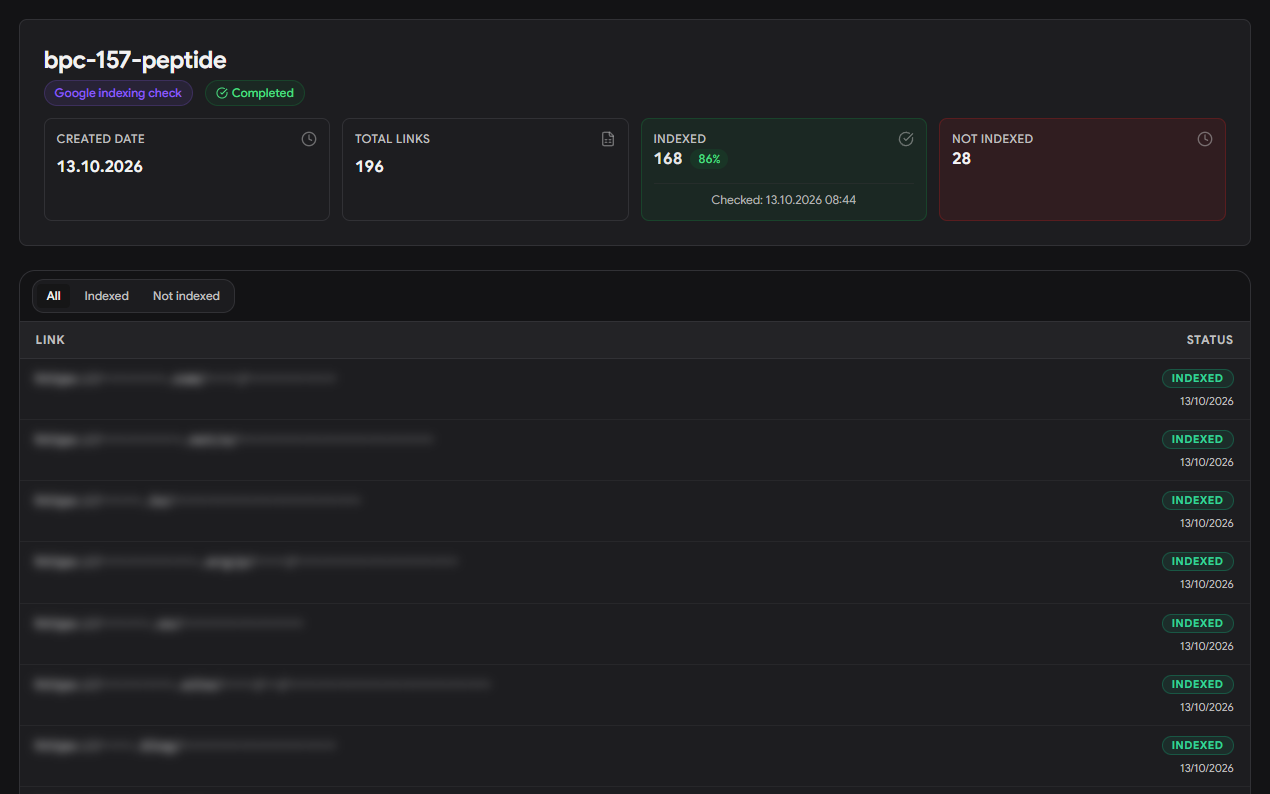
A backlink indexing check was conducted on October 13, 2026, to evaluate the indexation status of the reviewed URLs.
| Metric | Result |
|---|---|
| Total Links Checked | 196 |
| Indexed Links | 168 |
| Not Indexed | 28 |
| Google Indexation Rate | 85.71% |
| Not-Indexed Rate | 14.29% |
Indexation Rate Calculation
168 indexed URLs ÷ 196 total URLs checked × 100 = 85.71%
The check found that 168 of the 196 reviewed backlink URLs were indexed, while 28 were not indexed at the time of verification.
These results provide a measurable snapshot of backlink indexation across the reviewed link set.
Backlink Index Monitoring
Index monitoring is an important part of evaluating a link-building campaign after delivery.
For this project, the indexing check established a baseline that can be used for subsequent monitoring and quality review.
The next monitoring steps include:
- Rechecking URLs that were not indexed during the initial check.
- Reviewing page accessibility, crawlability, and noindex directives.
- Checking canonical tags, redirects, and potential duplication issues.
- Evaluating the quality and relevance of the linking pages.
- Tracking changes in indexed and non-indexed URL counts over time.
A URL that is not indexed at one check may be indexed later, while indexation status can also change over time.
Key Findings
The campaign’s initial indexing check produced three primary findings:
1. Multi-category link delivery
The campaign used multiple link-placement categories through the Custom Link Foundation service.
2. Measurable indexation results
A total of 168 out of 196 reviewed backlink URLs were indexed, representing an 85.71% indexation rate.
3. Clear monitoring priorities
The remaining 28 URLs provide a defined group for further technical review and subsequent indexation checks.
Conclusion
The BPC-157 campaign demonstrates SerpRanky’s multi-category approach to backlink foundation building and indexation monitoring.
As of October 13, 2026, the review identified 168 indexed URLs out of 196 checked, resulting in an 85.71% Google backlink indexation rate.
The next step is to monitor the remaining URLs, investigate potential indexation barriers, and evaluate additional SEO performance indicators where data is available.
Campaign Summary: 196 links checked · 168 indexed · 28 not indexed · 85.71% indexation rate.
Note: Indexation status does not independently prove ranking improvements, increased organic traffic, or direct SEO benefits. Those outcomes require separate performance data.